 how-to
How Do You Teach the Nativity Through First-Person Storytelling?
Last Updated: October 26, 2026
Quick Summary
Teach the Nativity through first-person storytelling by retelling the account in one character's voice, using I and we, in a script two to four minutes long. Read Luke 2 aloud first, assign each child a character card, then run a 20-minute lesson of prompts, freeze-frame retelling, and a one-line closing.
- A first-person Nativity script is usually two to four minutes long and carried by one character.
- The 20-minute lesson plan runs from reading Luke 2 to a one-line closing sentence.
- Ages 3-5 get one or two sentences with a prop; ages 9-12 write a full monologue.
- Keep the Luke 2 and Matthew accounts separate and let children notice the differences.
- Close every telling with one line about the promise.
Table of Contents
- Why First-Person Storytelling Makes the Nativity Stick
- Step 1: Choose Your Source and Set the Scene
- Step 2: Write a First-Person Nativity Script That Fits Your Family
- Step 3: Build a Nativity Monologue for Kids (Ages 3-12)
- Step 4: Turn the Story into an Interactive Christmas Bible Story
- Step 5: Plan Advent Storytelling Ideas for Families
- Common Mistakes That Break the Spell (and How to Fix Them)
- Choose Your Family's First Step Into the Story
- Frequently Asked Questions
Why First-Person Storytelling Makes the Nativity Stick
First-person storytelling retells a true account through the eyes of someone who lived it, using "I" and "we" instead of distant narration. Teach the Nativity this way and children can imagine the story from a character's perspective.
The Bible itself invites this. Luke opens his account by saying he carefully investigated everything from the beginning, the story was passed along by people who were there.
Luke 2, the birth of Jesus account
Now let's build it, step by step.
Step 1: Choose Your Source and Set the Scene
Start with the Bible text, then choose the room. Read the account aloud once before you plan anything and let the children hear the actual words.
Set the scene simply: dim the lights, clear the floor, place a few chairs in a half circle, and set out your Nativity figures where everyone can see them.
Luke 2 vs. Matthew: What Each Account Actually Says
Luke 2 gives you the shepherds, the manger, the angel, and the journey from Nazareth to Bethlehem. Matthew gives you Joseph's side, the wise men, and the flight to Egypt, different windows onto the same night. Keep the accounts separate and let children notice the differences.
Ask one question to anchor the lesson: "Whose eyes are we looking through today?"
Step 2: Write a First-Person Nativity Script That Fits Your Family
A first-person Nativity script is a short retelling in one character's voice, using "I" and "we," usually two to four minutes long. Write it in your own words and let one character carry each scene.
Use this simple frame:
- Who am I? Name the character in one line
- What did I see? Two or three plain details
- What did I feel? One honest emotion
Sample Script: Mary's Version of Events
I am Mary. I was in Nazareth when the angel came, and my heart nearly stopped. Then I said yes.
The road to Bethlehem was long and dusty, and I was heavy with child. When the pains came, there was no room. So we stayed where the animals were kept, and I wrapped my son in cloths and laid him in the manger.
I did not fully understand that night.
Read it aloud once, then hand the script to a child and let them read it back.
Step 3: Build a Nativity Monologue for Kids (Ages 3-12)
A Nativity monologue for kids is a single-character speech short enough for a child to memorize or read aloud. Match the length and language to the age.
Here is how we would adapt it:
- Ages 3-5: One or two sentences with a prop. "I am the shepherd. I was scared. Then the angel said, do not be afraid."
- Ages 6-8: Four to six sentences, read from a card, with one feeling word
- Ages 9-12: A full monologue with a beginning, a middle, and a closing line they write themselves
If a child stumbles twice, cut the script in half.
Keep simple props nearby: a scarf, a small wooden star, a bit of rope. A prop gives small hands something to do while the words come out.
Step 4: Turn the Story into an Interactive Christmas Bible Story
An interactive Christmas Bible story invites children to act, answer, and choose, rather than sit and listen. The story stays the same. The telling becomes a conversation, and in first-person storytelling, the conversation happens in character.
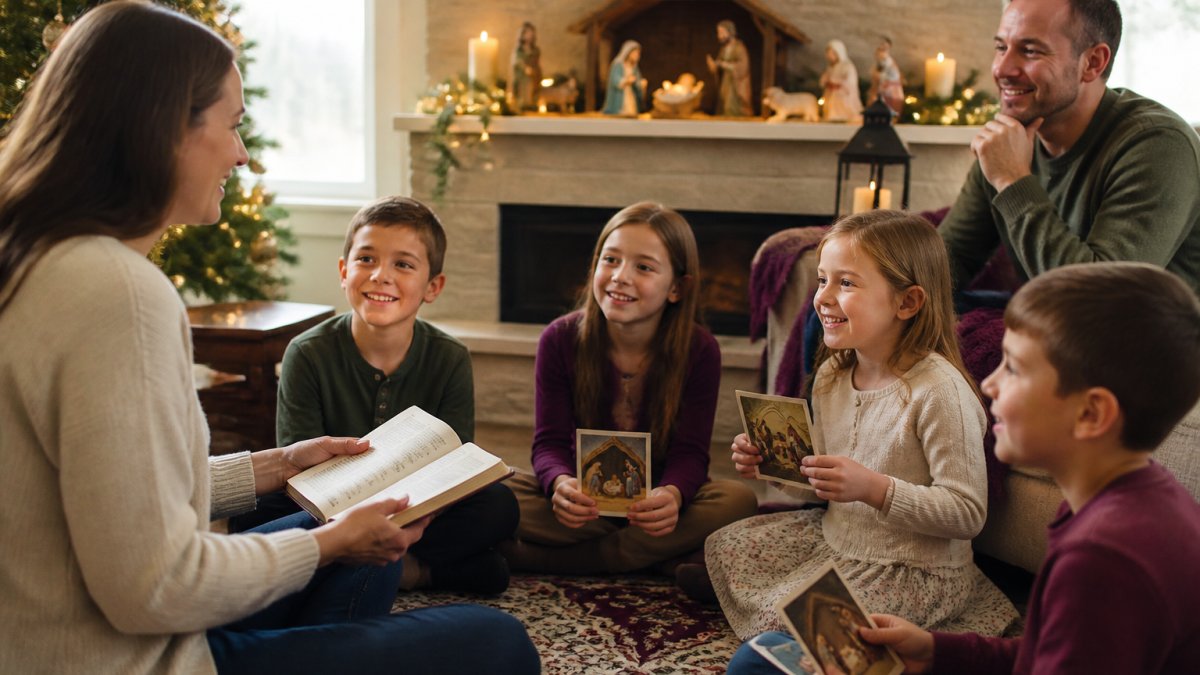
The 20-Minute First-Person Lesson Plan
Here is a timed sequence you can run tonight with any age group.
Advent Mailed Experience - Christmas Collection →
- Minutes 0-3, Read the source. Read Luke 2:1-20 aloud straight from the Bible. No commentary yet. Let the actual words land.
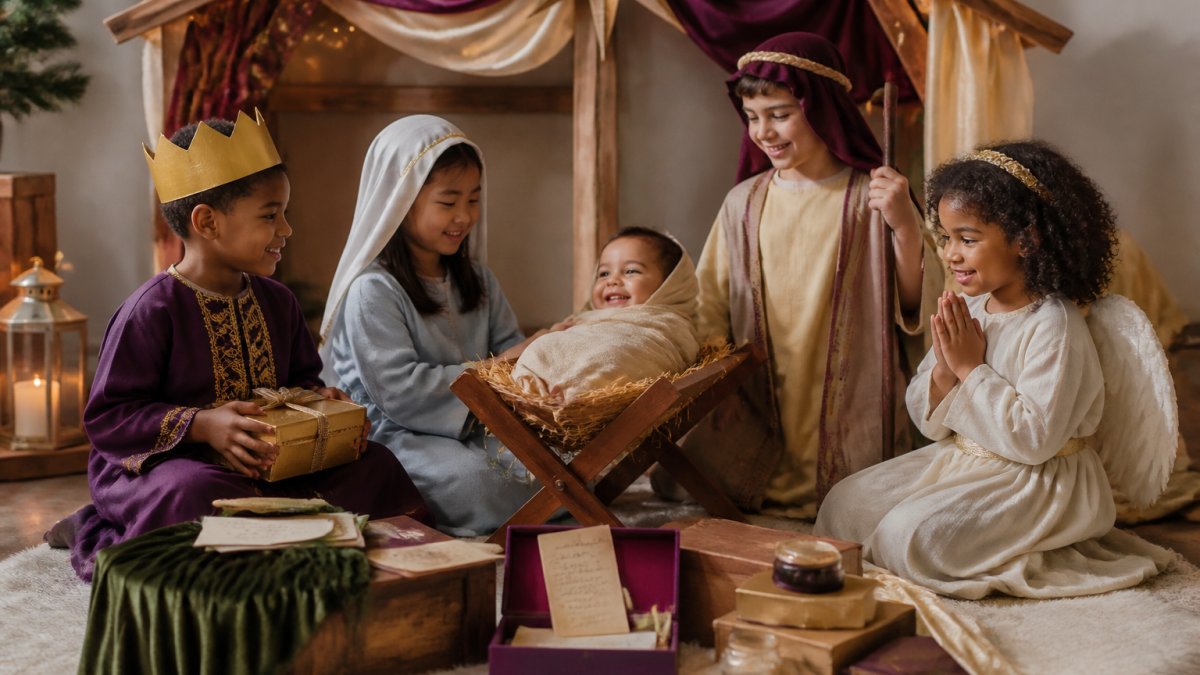
- Minutes 3-6, Assign a viewpoint. Hand each child a character card: Mary, Joseph, a shepherd, an angel, a wise man, the innkeeper. Say: "Today you are not you. You are them. You saw this happen."
- Minutes 6-12, First-person prompt round. Go around the circle and ask each child one question in character. Use the prompts below.
- Minutes 12-17, Freeze-frame retelling. One child narrates a scene in first person ("I was watching my sheep when...") while the others freeze in tableau. Tap a frozen child on the shoulder and ask, "What are you seeing right now?"
- Minutes 17-20, One-line closing. Each child finishes the sentence: "The thing I will never forget is..." Close with a single sentence about the promise.
Character-Perspective Prompts You Can Use Immediately
These age-appropriate first-person prompts cover the four characters children connect with most. Read them as written or hand them out on cards.
- Mary: "I am Mary. When the angel spoke to me, my first feeling was ___. The road to Bethlehem smelled like ___. When I held him, I thought ___."
- Joseph: "I am Joseph. The night the baby came, I was worried about ___. What surprised me most was ___. I want you to know ___."
- A shepherd: "I am a shepherd. I was on the hillside when the sky lit up. I was afraid because ___. When we ran to the manger, I saw ___."
Sample Mini-Script: The Shepherd's First Person
I am a shepherd. I was on the hillside with my sheep, and it was very dark. Then an angel stood in front of me, and I was so scared I dropped my staff. The angel said, "Do not be afraid." And then the sky was full of angels singing. I ran to Bethlehem as fast as I could. I saw a baby lying in a manger.
Read it once, then hand it to a child.
How to Check Comprehension, Empathy, and Recall
After the retelling, ask three open-ended questions, one for each skill. Do not grade them. Just listen.
- Recall: "Tell me one thing that happened, in your character's voice."
- Empathy: "Which character do you think felt the most afraid? Why?"
- Comprehension: "Why did the shepherds go to Bethlehem? What did the angel tell them?"
Adaptations for Different Ages and Needs
- Preschoolers (3-5): One prompt, one prop, one sentence. "I am the shepherd. I was scared. Then I was happy."
- Primary (6-8): Four to six sentences read from a card, with one feeling word.
- Older students (9-12): A full monologue with a beginning, middle, and closing line they write themselves.
A Note on Sensitive Contexts
In a classroom or mixed-belief setting, frame the activity as "telling a story from a character's point of view" rather than a devotional exercise. The activity can be framed as telling a story from a character's point of view.
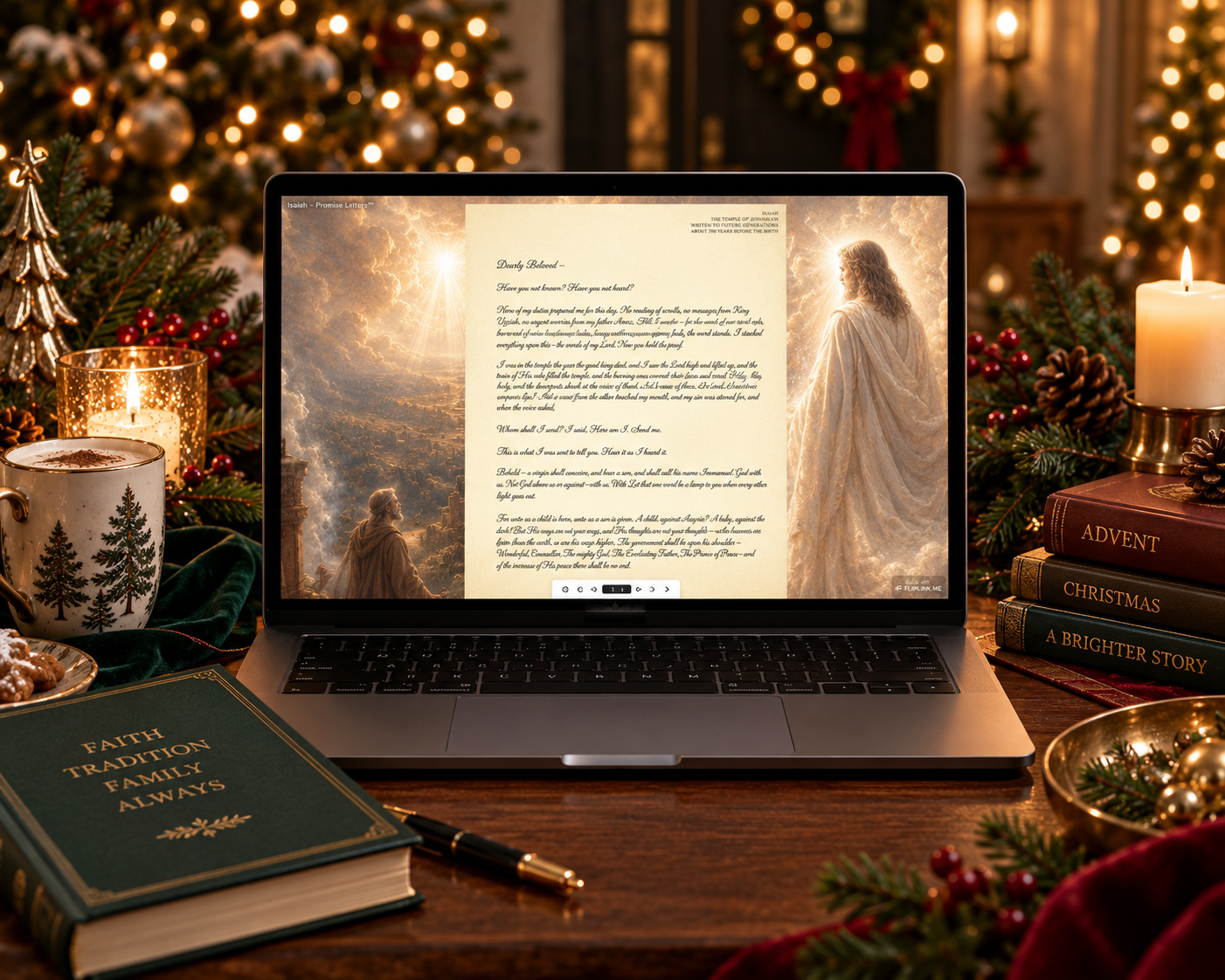
If you want a ready-made version, The Digital Experience - Christmas Collection delivers illustrated letters from biblical characters straight to your inbox, so the story arrives already in voice, and the promise letters make the first-person telling feel like a gift, not a lesson.
The goal is participation, not performance.
Step 5: Plan Advent Storytelling Ideas for Families
Advent storytelling ideas for families can follow the calendar. One short telling each week is one option. The waiting is part of the lesson, and the promise letters are built for exactly that rhythm.
Here is a simple four-week rhythm, with a first-person script and a reflection prompt for each week.
Week 1: The Angel Visits Mary
- Character: Mary
- Script: "I am Mary. I was in Nazareth when the angel came, and my heart nearly stopped. He said I would have a son, and I said yes. I did not understand. But I said yes."
- Reflection prompt: "What is one thing you would have been afraid of if you were Mary?"
Week 2: The Journey to Bethlehem
- Character: Joseph
- Script: "I am Joseph. The road to Bethlehem was long and dusty, and Mary was heavy with child. When we got there, every door was full. I was worried. I did not know what to do. But I found a place where the animals were kept, and I stayed with her."
- Reflection prompt: "What is one thing Joseph had to trust God for on that road?"
Week 3: The Shepherds and the Angels
- Character: A shepherd
- Script: "I am a shepherd. I was on the hillside when the sky lit up. I was so scared I dropped my staff. The angel said, 'Do not be afraid.' Then the sky was full of angels singing. We ran to Bethlehem as fast as we could."
- Reflection prompt: "Why do you think the angels told the shepherds first?"
Week 4: The Wise Men and the Gifts
- Character: A wise man
- Script: "I am a wise man. I traveled a long way because I saw a star. I brought gold, frankincense, and myrrh. When I knelt down, I felt small. I felt like I was in the presence of a king."
- Reflection prompt: "What gift would you bring to the baby Jesus?"
How to Close Each Week
End every telling the same way: ask one child to finish "The promise I am holding this week is..." then read one line of Scripture aloud.
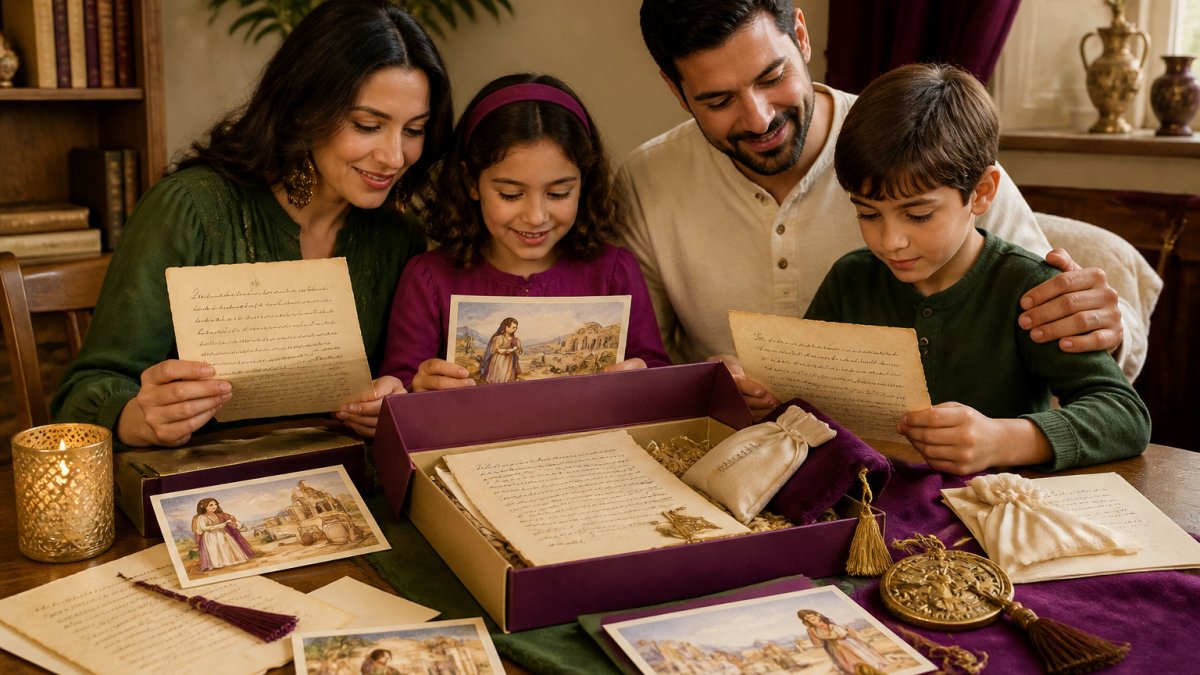
For families who want the story to arrive in the mail, the Advent Mailed Experience - Christmas Collection sends twelve handwritten letters from biblical characters on the Advent schedule, along with illustrated postcards and paper ornaments for the tree.

If you want more ideas for keeping Christ at the center of the season, our guide on how to keep Christ in Christmas as a family pairs well with this plan.
Common Mistakes That Break the Spell (and How to Fix Them)
The fastest way to lose a child's attention is to turn the story into a test. The second fastest is to make it too long. Here is how to avoid both.
- Overloading with characters. Fix: one voice per telling.
- Correcting every stumble. Fix: let the retelling breathe, then gently read the verse aloud afterward.
- Skipping the feelings. Fix: ask "How did they feel?" before "What happened?"
Save the accuracy notes for the read-aloud.
A quick fix table to keep nearby:
| Problem | Fix | Why It Works |
|---|---|---|
| Child freezes | Let them read from a card | Removes memory pressure |
| Story drags | Cut to two minutes | Attention spans are short |
| Kids argue over roles | Draw names from a bowl | Takes the blame off you |
| Everyone talks at once | Use a talking prop | One voice at a time |
| Story feels flat | Add sound effects | Engages the senses |
Choose Your Family's First Step Into the Story
You do not need a stage, a script library, or a perfect voice. You need one character, one short script, and ten quiet minutes. Start with Mary this week and let the story grow from there.
If you would rather begin with something tangible under the tree, The Gift Set - Christmas Collection gathers all twelve letters in gold wax-sealed envelopes with postcards, ornaments, and a printed story guide that introduces each biblical character.

Frequently Asked Questions
How do you tell the Nativity story from a first-person point of view?
Pick one character, such as Mary, Joseph, or a shepherd, and speak as if you are that person remembering the events. Use 'I' and 'we,' describe what you saw and felt, and keep the biblical facts from Luke 2 or Matthew intact. Start with a simple opening like 'I will never forget the night the sky lit up,' then walk through the journey, the birth, and the visitors in order. First-person storytelling works best when you stay close to the Bible account and add only sensory details, not new events.
What is a good Nativity monologue for kids to perform?
A short monologue from a shepherd or an angel is one option. For a shepherd: 'I was watching my sheep when the sky filled with light. An angel told us a Savior was born, so we ran to Bethlehem and found Him in a manger.' Keep it brief, let the child hold a prop like a staff or a star, and practice aloud.
How long should a family Nativity storytelling activity take?
You could plan for 15-20 minutes for younger children and up to 30 minutes for ages 8 and older. One possible rhythm is five minutes to set the scene and read the Bible passage, five to ten minutes for the first-person retelling or monologue, and five minutes for questions and prayer. An Advent storytelling series could use one short session per week through December.
How can first-person storytelling help children understand the Christmas story?
When a child hears the Nativity in the voice of Mary or a shepherd, the story is told from a character's perspective. First-person storytelling invites children to imagine what the characters saw, heard, and felt. Pairing the story with a hands-on element, such as drawing a scene, holding an ornament, or acting out a line, is another activity option. A written letter or keepsake from a biblical character can also be part of an Advent experience.
The story of the Nativity was never meant to stay on a page. It was meant to be told, out loud, by people who have let it change them. That is what The Promise Letters™ exists for: handwritten letters from biblical characters, illustrated keepsakes, and ornaments that turn Advent into a journey your family walks together. Get started with The Promise Letters™ and give your family a Christmas story they will carry for years.