 how-to
How to Study the Bible Through Storytelling
Last Updated: October 26, 2026
Quick Summary
To learn how to study the Bible through storytelling: read the whole passage twice, map its beginning, ending, and conflict, then work through observation, interpretation, and application in three separate columns. Retelling the story aloud in your own words and checking the gaps against the text deepens what you notice.
- Read the full passage twice before writing anything, letting the whole scene wash over you first.
- Keep observation, interpretation, and application in three columns and never mix them.
- Retell the story aloud, mark missed details, then retell again with corrections.
- Assign the passage a week ahead and spend at least half the group meeting on observation.
- For families, read aloud, ask two concrete questions, and let children retell the story.
Table of Contents
- Why Storytelling Opens Up Scripture
- A Step-by-Step Bible Storytelling Method
- Bible Story Retelling Method: Making the Text Your Own
- Bible Storytelling Techniques That Bring Characters to Life
- Bible Study Questions for Stories
- Bible Storytelling for Small Groups and Families
- A Worked Example: Studying Jonah in Four Passes
- Choosing a Storytelling Resource for Your Advent Study
- Frequently Asked Questions
Why Storytelling Opens Up Scripture
Learning how to study the Bible through storytelling changes what you notice on the page. Instead of hunting for rules, you follow people.
At The Promise Letters™, we offer immersive, faith-based letter subscriptions designed to bring Scripture to life through the perspectives of key Biblical figures.
Here is the good news. You do not need a seminary degree to read the Bible as narrative. You need a method, a notebook, and a little patience.
Below, we walk through a repeatable method you can use on any passage, plus a worked example on Jonah.
The Bible as One Overarching Story
The Bible is not a pile of unrelated lessons. It is one story with a beginning, a long middle, and an ending that pulls everything together.
That big arc is often called the meta-narrative. Creation, fall, rescue, and restoration form the spine. Individual stories hang on that spine like branches on a tree.
When you place a passage inside the big story, details stop feeling random. A famine, a storm, or a baby born in a stable all carry weight because of where they sit in the arc.
How Narrative Structure Shapes Meaning
Narrative structure is the way a story is built: setup, conflict, turning point, and resolution. Biblical authors used these tools on purpose.
Literary devices appear all over Scripture. Repetition in Genesis. Irony in Jonah. Poetry in the Psalms. Genealogies that mark time.
Read with structure in mind, and you start asking better questions. Why does the story slow down here? Why does the author repeat that phrase? What changed between the beginning and the end?
A Step-by-Step Bible Storytelling Method
This is a three-step method for studying a Bible story. It can be used for a single scene or a whole chapter.
Step | What You Do | Time |
|---|---|---|
1. Read whole | Read the full passage twice, no notes | 10 min |
2. Map the arc | Mark beginning, ending, and conflict | 10 min |
3. Observe, interpret, apply | Work through three columns | 10 min |
Step 1: Choose a Passage and Read It Whole
Pick a story with clear action. Jonah 1, Ruth 1, Luke 15, or Mark 4 are good starting points.
Read the entire passage twice before you write anything. The first read is for feel. The second is for detail.
A common mistake is stopping mid-story to chase a footnote. Resist that. Let the whole scene wash over you first.
Step 2: Map the Beginning, Ending, and Conflict
Every story moves from somewhere to somewhere. Find the start, find the finish, then name the gap between them.
Ask three questions:
- Where does the scene open?
- Where does it close?
- What stands in the way?
In Jonah 1, the story opens with a command and closes with a fish. The conflict is Jonah running the opposite direction.
Write your answers in one sentence each. That sentence becomes your map.
Step 3: Observe, Interpret, Apply
This is the heart of the method. Keep three columns in your notebook and never mix them.
- Observation: what the text actually says. Words, people, places, repeated phrases.
- Interpretation: what the text meant to its first readers. Context, culture, author intent.
- Application: what it means for you now. One specific change.
The order matters. Observation feeds interpretation. Interpretation feeds application. Skip a column and you risk reading your own ideas into the text.
Bible Story Retelling Method: Making the Text Your Own
The Bible story retelling method is simple: tell the story out loud in your own words, then compare your version to the text. But the real value comes from doing it in structured passes, not just once.
Try this four-pass sequence:
- Silent read. Read the passage slowly, without marking anything.
- Memory retell. Close the Bible and retell the story out loud to yourself or a partner. Record it if you can.
- Gap check. Read the passage again and mark every detail you missed: names, numbers, repeated words, dialogue, geographic references.
- Second retell. Tell the story again, adding the details you skipped and correcting anything you got wrong.
The gaps in your first retelling can show you what your mind filtered out. Look for details such as minor characters, time markers, and repeated phrases.
For group study, pair people up and have each person retell the same passage. Compare what each person emphasized. The differences can provide a starting point for discussion.
A common mistake is retelling the story as a summary of its lesson rather than as a sequence of events. Resist the urge to moralize too early. Tell what happened first. Meaning grows out of sequence, not around it.
Bible Storytelling Techniques That Bring Characters to Life
Good Bible storytelling techniques do one thing: they make characters feel like people instead of symbols. Here is how.
Setting, Time Period, and Historical Context
Setting is not wallpaper. It shapes what characters can do.
The Digital Experience - Christmas Collection →
Ask where the story happens, when it happens, and what that place was like. A desert road, a fishing boat, a city gate. Each one limits and opens choices.
For historical context, use study Bible notes and reliable reference works. Note the government, the economy, and the religious climate of the period.
Imagining a Character's Perspective
Pick one character and ask what they saw, heard, and felt. What did they not know yet?
This is imaginative reading, not invention. You stay inside what the text allows. You do not add new events. You ask what the scene would have felt like from their seat.
A servant in the upper room. A soldier at the cross. A mother on the road to Bethlehem.
This practice invites you to consider a character's perspective while staying within what the text allows.
Bible Study Questions for Stories
Bible study questions for stories should push past "what happened" into "what does this reveal." Here is a set you can reuse on any passage.
- Who wants something in this scene, and what is it?
- What is the conflict, and who or what creates it?
- What does this story show about God's character?
- Where do you see yourself in this scene?
- What would change if you believed this passage this week?
- Which detail surprised you on the second read?
Write your answers before discussion. Begin with silent reflection.
Bible Storytelling for Small Groups and Families
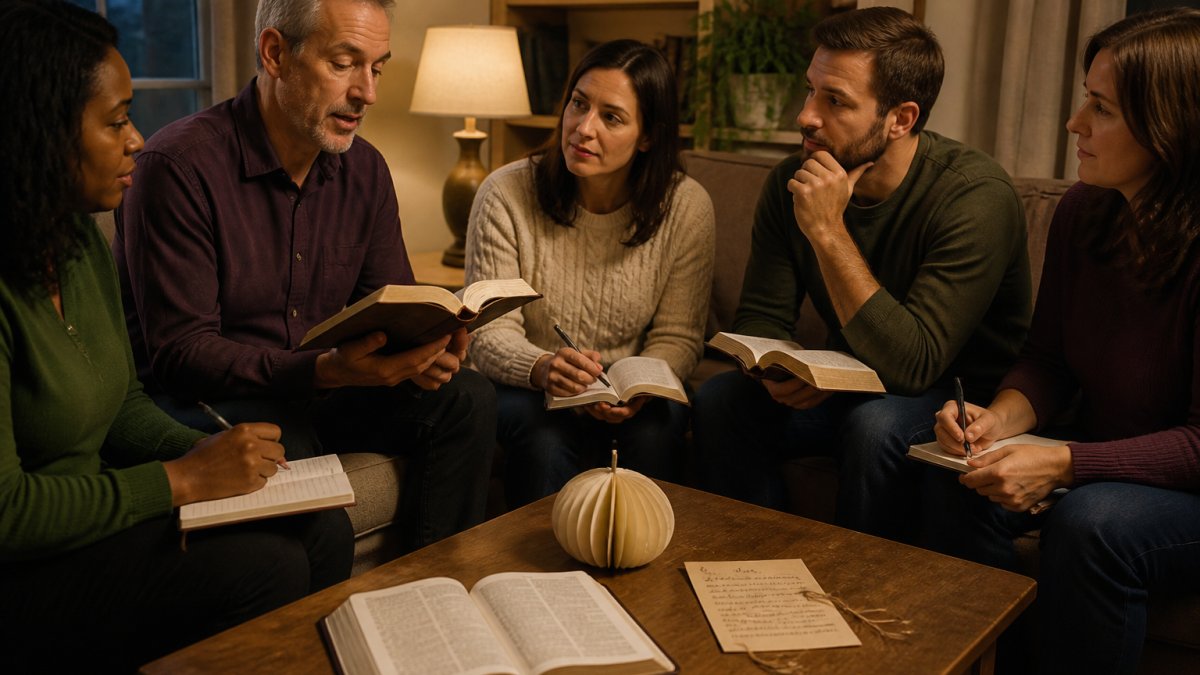
Groups need structure, not a lecture. Give everyone the same passage a week ahead, then walk through the three steps together. But the setting changes how you apply the method. Here is how to adapt storytelling study for individuals, small groups, and families.
Individual Study
Work through the three steps alone, but add one discipline: write your observations before you read any commentary or study notes. Most people jump to interpretation too quickly. A solo study benefits from a timed structure: 10 minutes reading, 10 minutes mapping, 10 minutes observing, interpreting, and applying. Keep a running list of questions you cannot answer and bring them to a pastor or a trusted study resource later.
Small Groups
Assign the passage a week in advance and ask each person to bring one observation, one question, and one application. In the meeting, walk through the three steps together, but let the group do the work. The leader's job is to keep the conversation in the observation column longer than feels comfortable. A common pattern is that groups want to jump to application in the first five minutes. Resist that.
Use the retelling method as a group exercise: pair people up, have each retell the story, then compare. The differences become the discussion.
Families
For families, shorten the method. Read the story aloud, ask two questions, and let children retell it in their own words.
For teenagers, add the observation-interpretation-application framework but keep it conversational. Ask them to name one detail they noticed and one question they have. Let the questions drive the study.
The Promise Letters™ offers handwritten letters from the perspectives of Biblical characters, along with illustrated keepsakes and ornaments. For more family ideas, see how to keep Christ in Christmas as a family.
A Worked Example: Studying Jonah in Four Passes
Here is the method on one passage: Jonah 1:1-16.
Pass one, read whole. Read the chapter twice. Note the storm, the sailors, and the fish.
Pass two, map the arc. Beginning: God speaks. Ending: sailors worship. Conflict: Jonah flees.
Pass three, observe and interpret. The sailors pray to their own gods, then to Yahweh. The sea calms only after Jonah goes overboard.
Pass four, apply. Where are you running from a clear instruction? Name one thing you have been avoiding this week.
Notice how the four passes move from facts to meaning to action. That is the whole method in miniature.
Choosing a Storytelling Resource for Your Advent Study
A resource should serve the text, not replace it. Look for three things: fidelity to Scripture, a clear format, and something that helps you stay in the story.
That is the design behind The Promise Letters™. Each collection tells the Christmas story through letters written from the perspective of biblical characters.
- The Digital Experience delivers 12 illustrated letters by email on the Advent schedule, with instant access to the first letter.
- The Advent Mailed Experience sends 12 handwritten letters, 12 postcards, and 12 paper ornaments through the mail.
- The Gift Set gathers all 12 letters in wax-sealed envelopes with a printed story guide.
Frequently Asked Questions
How can storytelling help you understand the Bible?
Stories carry meaning through structure, character, and conflict. When you study a passage as a story, you can notice who speaks, what changes between the opening and the closing, and what the author leaves unresolved. Consider the passage in its setting.
What questions should you ask when studying a Bible narrative?
Start with observation: Who is present? What happens first, and what changes by the end? Where does the scene take place? Then move to interpretation: Why does the author include this detail? What does the character want, and what stands in the way? Finally, ask application: What does this passage show about God, and how does it reshape one decision you face this week? Keep the three stages separate so your conclusions rest on what the text actually says.
How can you retell a Bible story without changing its meaning?
Retell what the passage states. Read the story aloud in your own words, keeping the same sequence of events and outcome. Compare your version against the passage afterward to check for details you may have changed or added.
How does Bible storytelling for small groups work in practice?
Give each person the same passage and five minutes to read it silently. One person retells it from memory while the group listens without interrupting. Then work through a short set of study questions together, and close by praying through one line of the text. Reading the passage ahead of time can help prepare for the meeting. Keep the retelling to one voice so the group hears a single interpretation before discussion opens.
Learning to read Scripture as story takes practice, and the first few passages may feel slow. That is normal, and it passes. The Promise Letters™ was built to help with exactly that: handwritten letters from biblical characters, illustrated keepsakes, and paper ornaments that keep the story in front of you all season. Get started with The Promise Letters™ and read the Christmas story the way it was told.