 ultimate-guide
How to Keep Christ in Christmas as a Family
And pivot the chaos of the season back to connection with the people who matter most...
Last Updated: October 26, 2026
Quick Summary
To keep Christ in Christmas as a family, write a simple Advent plan before December starts, giving each week one theme, one Scripture passage, one short activity, and one prayer. Then anchor the season in repeatable habits: a brief daily devotional, a family Christmas prayer, Christ-centered music, and a nativity set you handle and explain together. Decide your gift budget and guardrails in advance so the calendar points back to Jesus rather than crowding Him out.
- Map the four weeks of Advent plus Christmas week to a theme, Scripture, activity, and prayer.
- Keep each family devotional session under ten minutes and let a different member lead weekly.
- Read passages such as Isaiah 9:6, Micah 5:2, Luke 2, Matthew 2, and John 3:16 aloud.
- Leave the manger empty until Christmas Eve, then place baby Jesus in as the story is read.
- Set a gift budget before sales start and split it into give, share, and save buckets.
Table of Contents
- Why Keeping Christ in Christmas Still Matters
- Build a Week-by-Week Advent and Christmas Plan
- Christian Advent Activities for Families With Young Children
- Start a Family Advent Devotional That Actually Gets Used
- Christmas Bible Verses for Families to Read Aloud
- A Christmas Prayer for Families to Pray Together
- Keep Christ in Christmas Through Music, Worship, and Nativity Traditions
- Balance Faith, Consumerism, and Holiday Stress
- Choose Your Family's Advent Experience This Year
- Frequently Asked Questions
- Want A More Connected, Faith-Centered Christmas?
Why Keeping Christ in Christmas Still Matters
The season arrives earlier every year. Store displays appear before the autumn leaves fall, and by December the calendar is a blur of parties, parcels, and receipts. Somewhere in the middle of it, families who want to keep Christ in Christmas find themselves asking a quiet question: where did the Savior go?
That question is not odd or nostalgic. It is a decision about what your household actually celebrates. Christmas, at its root, is the celebration of the birth of Jesus - the moment Christian faith holds as the arrival of hope in human form. Everything else, the tree, the table, the gifts, hangs on that center.
At The Promise Letters™, we offer immersive, faith-based letter subscriptions designed to bring Scripture to life through the perspectives of Biblical figures. Below are ideas for building a plan that fits your household, from the first Sunday of Advent through Christmas morning.
Keeping Christ in Christmas can involve small, repeatable habits planned in advance.
Build a Week-by-Week Advent and Christmas Plan
A family Advent plan works best when it is written down before December starts. Map the four weeks of Advent plus Christmas week to a single theme each, then attach one short activity, one Scripture passage, and one prayer to every week. The plan below is designed to be adapted, not followed rigidly, pick the column that fits your household and skip what does not serve you.
Week | Theme | Scripture | Family Activity | Prayer Focus |
|---|---|---|---|---|
Week 1 | Hope | Isaiah 9:2-7 | Set up the nativity set, leaving the manger empty | For those waiting on God's promises |
Week 2 | Peace | Luke 1:26-38 | Read the prophecy passages aloud; light two candles | For calm in a busy season |
Week 3 | Joy | Luke 2:8-14 | Learn one hymn as a family; deliver a small gift to a neighbor | For gratitude and song |
Week 4 | Love | Matthew 1:18-25 | Serve someone who cannot repay you | For a generous heart |
Christmas week | The birth of Jesus | Luke 2:1-20 | Read the Nativity story aloud on Christmas Eve; place baby Jesus in the manger | For joy and worship |
How to adapt it for your household:
- Families with young children: Keep each activity under ten minutes and repeat the same short prayer all week. Repetition builds memory.
- Families with teens: Let a different teenager lead each week's reading and prayer. Ownership matters more than polish.
- Mixed-faith or extended-family gatherings: Choose the Scripture and activity that focus on hope, peace, joy, and love without assuming everyone shares the same beliefs. Invite rather than instruct.
- Limited time or shift work: Combine weeks into two longer sessions, or use the table as a menu rather than a schedule.
Write the plan on paper and put it where everyone can see it. A plan that lives only in your head will lose to the calendar every time. If your church publishes an Advent schedule, build your home plan around it rather than competing with it, so Sunday worship, midweek services, and family devotions reinforce the same message.
Christian Advent Activities for Families With Young Children
You can try short, hands-on activities and repeat them with young children.
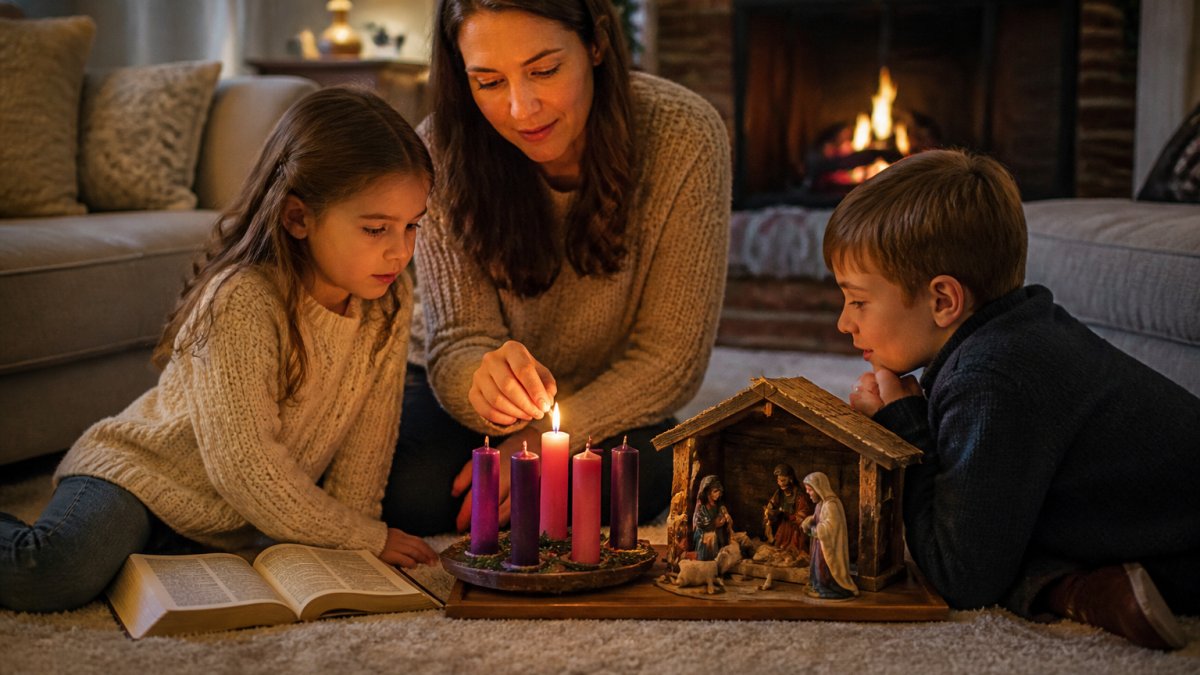
What works well with little ones:
- A nativity set they can touch. Use a wooden or cloth set, not the porcelain heirloom, and let the children move the figures as you tell the story.
- One candle, one song. Light a single candle each evening and sing the same short carol. The ritual matters more than the length.
- A paper chain of promises. Each link carries one short phrase about God's promises, and the chain shortens as Christmas approaches.
- Acting it out. Five minutes of dress-up as shepherds or angels will stick longer than a twenty-minute lesson.
You might choose a short devotion that fits your family's routine.
Start a Family Advent Devotional That Actually Gets Used
The devotional that gets used is the one that is already open on the table. An Advent devotional can be easier to use when it fits your family's routine.
Here is how we would set one up to survive December:
- Choose a fixed time and place, such as after dinner at the kitchen table
- Keep each session under ten minutes
- Read one short passage aloud, then ask one question
- Let a different family member lead each week
- Keep a simple record, such as a jar of written prayers, so the family can see what they have done
If you want to see how a Scripture-based letter subscription works as a devotional, you can explore the Promise Letters and judge whether the format suits your household. A letter written from the perspective of a Biblical figure offers another way to engage with a familiar story, and illustrated keepsakes and ornaments are part of the Promise Letters™ experience.
Christmas Bible Verses for Families to Read Aloud
Some passages carry the whole story in a few lines, and those are the ones worth reading aloud together. Assign one verse per evening, or read the full set on Christmas Eve.
These verses work well with mixed ages:
- Isaiah 9:6, the promise of a child born to us
- Micah 5:2, the prophecy of Bethlehem
- Luke 2:1-7, the journey and the birth
- Luke 2:8-14, the angels and the shepherds
- Matthew 2:1-12, the wise men and their gifts
- John 3:16, the reason behind the birth
For families who treasure the King James Version, reading these passages aloud can be part of the tradition. Read slowly. Let the language settle. Ask one question afterward: what did you notice?
A Christmas Prayer for Families to Pray Together
A family Christmas prayer does not need polished language. It needs honesty and a fixed place in the evening. Keep it to four movements: gratitude, confession, request, and hope.
Here is a simple prayer you can pray as written or adapt:
“Lord, thank You for sending Jesus into the world. Thank You for the hope His birth brings to our home. Forgive us for the ways we have let busyness crowd out Your presence this season. Help us to love one another well and to remember the good news we celebrate. Let our home be a place where Your peace is felt. Amen.”
Pray it at the same time each evening, and let children add their own lines. Children can add their own lines to the family prayer.
WANT YOUR CHILDREN TO RUN TO THE MAILBOX? →
Keep Christ in Christmas Through Music, Worship, and Nativity Traditions
A hymn learned in childhood can become part of a family's Christmas tradition.
Build a short family playlist of Christ-centered songs and sing them together, imperfectly, in the kitchen. Classic hymns such as "O Come, O Come, Emmanuel" and "Joy to the World" carry the gospel in their lines. Add one or two worship songs your church sings so Sunday and home feel connected.
Nativity traditions deserve the same care. Set up the nativity scene together and explain each figure. Some families leave the manger empty until Christmas Eve, then place the baby Jesus in at the moment the story is read. Others add the wise men slowly across the season, arriving on Epiphany. Either way, the set becomes a teaching tool rather than decoration.
If you want to bring the Christmas story to a wider group, you can bring the Christmas story to life for your congregation with a resource designed for groups as well as households.
Balance Faith, Consumerism, and Holiday Stress
Faith and gift-giving are not enemies, but the modern Christmas calendar can crowd out the very thing it celebrates. The pressure to buy more, host more, and attend more leaves families exhausted by December 25 and relieved when it ends. That exhaustion is a signal worth listening to, and a practical plan can help you respond to it without turning Christmas into a joyless exercise.
A simple mechanism: the three-bucket gift plan.
Before the sales start, divide your gift list into three buckets: give, share, and save. The give bucket covers immediate family and close friends. The share bucket covers teachers, neighbors, and service providers. The save bucket covers charitable giving and unexpected needs. Set a total budget, then assign a percentage to each bucket, many families find a 70/20/10 split workable, but the exact numbers matter less than deciding them in advance. Write the numbers down and keep the list where you shop.
Guardrails that actually hold:
- Set a gift budget before the sales start and write it down
- Choose one or two service projects instead of a dozen events
- Protect one quiet evening each week with nothing scheduled
- Say no to good things so you can say yes to the best ones
- Talk openly with children about why you give, not just what you give
- Use a shared calendar and mark one day each week as a family rest day
- Agree on a spending limit for adult gifts, or replace them with a shared experience
A balanced view of consumerism. Gifts are part of the Christmas message, the wise men brought gold, frankincense, and myrrh, and there is nothing wrong with giving well. The question is whether the giving points back to the Savior or replaces Him. Giving deliberately, including to people who cannot repay, can be one way to reflect on the gospel. The goal is not to reject the season's abundance but to direct it toward love of God and neighbor.
Choose Your Family's Advent Experience This Year
You now have a plan, a devotional structure, verses, a prayer, and guardrails for the busy weeks. The remaining decision is how your family will mark the season this December.
Choose your Christmas experience with a Scripture-based letter subscription that brings the voices of the Bible into your home, or start smaller with a single season and see how your family responds. The Promise Letters™ offers handwritten letters from the perspective of Biblical characters, illustrated keepsakes, and meticulously designed ornaments. Families with young children, grandparents looking for meaningful gifts, and church leaders seeking resources for their congregations are among the audiences for these experiences.
Frequently Asked Questions
Why keep Christ in Christmas?
Christmas marks the birth of Jesus, the event Christians believe brought the Savior into the world. Keeping Christ at the center keeps the season connected to the gospel rather than only to gifts and decorations. That does not mean rejecting every secular custom. It means deciding in advance which traditions carry the Christmas message and making room for Scripture, prayer, and worship alongside the celebration.
How can families keep Jesus at the center of Christmas?
Pick a small number of traditions and repeat them every year. Read the Nativity story from Luke 2, light Advent candles, pray a short Christmas prayer for families at dinner, and sing one hymn together. Consistency can be one way to make a family tradition part of the season.
What are some Christian Advent activities for families with young children?
You could try a nativity set, a paper chain with one Bible verse per link, or a candle lighting with a short reading.
What Christmas Bible verses for families work best for reading aloud?
You could read Luke 2:1-20 in short sections across several evenings, and add Isaiah 9:6, Matthew 1:20-23, or John 3:16.
How do I start a family Advent devotional that we will actually finish?
Choose a format that requires no preparation: a short reading, one question, one prayer. Set it at a time you already gather, such as dinner or bedtime, so it does not compete with the schedule. If you miss a night, you can catch up rather than restart.
How can churches help people focus on Christ during Advent?
Churches can send families home with a simple Advent reading plan, host a short midweek candle-lighting service, and offer small group materials that match the Sunday sermons. A congregation could provide an Advent devotional for households to use.
Want A More Connected, Faith-Centered Christmas?
The challenge is not finding good ideas. It is choosing a few and doing them faithfully when December gets loud. The Promise Letters™ exists to make that choice easier, with immersive storytelling that places your family inside the historic moments of Scripture, physical keepsakes that mark the season, and Advent and gift set experiences built around the promises of God. Get started with The Promise Letters™ and give your family a Christmas they will remember for the right reasons.