 blog
How to Choose Bible Study Resources for Young Children
Last Updated: October 26, 2026
Quick Summary
Choose bible study resources for young children by matching them to your child's learning style, attention span, and current knowledge rather than shopping by age range alone. Look for short, repeatable formats your child will actually reach for, and start with free options before paying for a lasting ritual.
- Ask how your child takes in stories, how long they can sit, and what they already know.
- Keep story telling under five minutes for young children and ask one open question afterward.
- Young children need rescue stories; older children need choice stories about characters deciding.
- Try free printables and videos first, then pay for a repeatable ritual format.
- Read one part of the Christmas story each week during Advent, not all at once.
Table of Contents
- What Makes Bible Study Resources for Young Children Actually Work
- How to Teach Bible Stories to Children Without Losing Their Attention
- Want to Bring the Story Home This Advent?
- Bible Stories for Kids: Which Ones Land at Which Age
- Other Resources Worth a Look
- Children's Bible Study Activities That Make the Story Stick
- Family Bible Study Ideas for Busy Weeks
- Free vs Paid Bible Study Resources: What You Get for the Trade
- Ready for an Advent Experience Your Family Returns to Every Year?
- Bringing the Christmas Story to Life for Your Child This Advent
- Frequently Asked Questions
- Ready to Start The Promise Letters™ This Advent?
What Makes Bible Study Resources for Young Children Actually Work
The best bible study resources for young children treat the child as a person with a real spiritual life, not a container to fill with facts.
Match the Resource to the Child, Not the Shelf
Most parents shop by age range. That is a reasonable start, but two five-year-olds can sit at very different places.
Ask three questions before you buy anything:
- How does your child take in stories? Some kids need pictures. Some need to act it out. Some need to hear it.
- How long can they sit? A resource built for ten quiet minutes will frustrate a child who lasts three.
- What do they already know? A child raised on Bible stories at bedtime needs more than a beginner overview.
The common mistake is buying what looks best on a shelf or screen. Buy the one your child will actually reach for.
Bible study resources are not curriculum to complete. They are doorways. The door only matters if the child walks through it.
How to Teach Bible Stories to Children Without Losing Their Attention
Children can engage with a story before discussing its meaning.
Here is a simple two-part method.
Tell It, Then Ask It
Tell it. Read or retell the story with energy. Use voices. Pause at the tense parts. Keep it short.
Ask it. Then open one question, not five. "What would you have done?" beats "What is the lesson?" every time.
A few habits that help:
- Keep the telling under five minutes for young children.
- Let them interrupt. Questions mean they are with you.
- Skip the moral for now. Let the story do the work.
- Return to the same story more than once. Repetition builds memory.
For families who want a hand with this, the family Advent letters offer an Advent experience centered on the Christmas story.
A few other resources are worth a look too. Bible App for Kids turns stories into interactive read-alongs for younger children. The Beginner's Bible leans on simple illustrated retellings for first exposure. Awana builds habits around Scripture memory in a group setting. For Christmas specifically, The Promise Letters: Christmas Collection walks a family through the Christmas story one letter at a time.
Want to Bring the Story Home This Advent?
If the tell it, then ask it method feels right for your family, The Promise Letters' Advent experience gives you a new story to tell each night of the season, written from the perspective of the people who lived it and paired with keepsakes your child can hold.
Bible Stories for Kids: Which Ones Land at Which Age
Not every story fits every age. Some are vivid and simple; others carry violence or grief a young child is not ready to hold. The useful question is not just which story, but which developmental stage and learning style the child is in.
Here is how we would sort the stories, then how to adapt them.
Age | Best story types | What to avoid | Why it works |
|---|---|---|---|
2-3 | Creation, Noah's ark, baby Moses | Violence, death, judgment | Simple images, repetition, animals |
4-5 | David and Goliath, Daniel and the lions, Jonah | Long speeches, complex plots | Clear hero, clear danger, clear rescue |
6-8 | Joseph, Ruth, the Nativity, parables | Dense genealogy, abstract law | Character and choice drive the story |
9-12 | Exodus, Esther, Paul's journeys | Nothing much, within reason | Kids can handle tension and nuance |
Two rules of thumb:
- Young children need rescue stories. They understand help arriving.
- Older children need choice stories. They understand a character deciding.
Match the story to the developmental stage, not just the birthday
A child's age tells you less than their stage. Watch for these signals.
- Babies and toddlers (roughly 0-2). They are not following plot. They are absorbing tone, rhythm, and the feeling of being read to. Short board-book versions of Creation, Noah, and the Nativity work because the images and repetition carry the meaning. Keep sessions under two minutes and expect repetition, not comprehension.
- Preschoolers (roughly 3-5). They are concrete thinkers. They understand a hero, a danger, and a rescue, but not metaphor or abstract law. David and Goliath, Daniel and the lions, and Jonah land because the stakes are physical and visible.
- Early elementary (roughly 6-8). They can follow a character across several scenes and begin to reason about motive and choice. Joseph, Ruth, and the parables work because the child can ask 'why did he do that?' and mean it.
- Older elementary (roughly 9-12). They can hold tension, nuance, and moral complexity. Exodus, Esther, and Paul's journeys give them something to wrestle with rather than just admire.
Other Resources Worth a Look
If you want more ways to bring these stories to life, a few other resources are worth checking out. The Jesus Storybook Bible retells the Bible as one unfolding story for younger children, while The Action Bible uses a comic book format that tends to land with older kids who want more detail. The Bible App for Kids from YouVersion adds an interactive option for screen time that still points back to scripture. And for something built specifically for the Advent season, The Promise Letters: Christmas Collection walks through the story night by night with letters written from the perspective of the people who lived it.
Adapt the same story to different learning styles
- Visual learners need to see the scene. Illustrated Bibles, story cards, and drawing the story after reading all work.
- Auditory learners need to hear it. Read aloud with voices, use audio story versions, and let them retell it back to you.
- Hands-on learners need to move. Act it out, build it with blocks, or hold an object connected to the story while you tell it.
- Emerging readers need to participate in the text. Let them read the short lines, point to words, or hold the book and turn the pages.
Different learning styles are not a problem to fix; they are a map to follow.
Children's Bible Study Activities That Make the Story Stick

Children's Bible study activities can be small, physical, and repeatable.
Try these:
- Draw the scene. Read a story, then have your child draw what they saw in their mind.
- Act it out. Two minutes of play-acting can be an alternative to ten minutes of explanation.
- Build it. Blocks for Jericho, a blanket boat for the storm on the lake.
- Retell it back. Ask your child to tell you the story. Gaps show you what to revisit.
- One question a day. Put a single question on the fridge and talk about it at dinner.
Some children learn by hearing, some by seeing, some by moving.
Family Bible Study Ideas for Busy Weeks
Family Bible study ideas can be planned for a busy week as well as a calm one.
Build a routine that can fit into a busy week.
- Mealtime reading. One short passage while everyone eats. No prep.
- Car questions. One question on the school run. That is the whole study.
- Bedtime story. One Bible story, same time each night.
- Weekly review. Sunday evening, ask what everyone remembers.
- A shared keepsake. Something physical the family returns to together.
A letter, an ornament, or an illustrated keepsake can give a family a starting point.
If you want more options, a few resources stand out. The Jesus Storybook Bible is a well-loved choice for story-style reading. The Bible App for Kids from YouVersion adds interactive stories for screen time that still center on scripture. And The Promise Letters: Christmas Collection turns the Christmas story into a letter a child opens each day of the season.
For parents who want to keep Christ at the center of the season, the guide to keeping Christ in Christmas as a family is another resource to explore.
Free vs Paid Bible Study Resources: What You Get for the Trade
Free Bible study resources for young children include printable lessons, coloring pages, short animated videos, and children's Bible overviews. Consider what you want a resource to provide when deciding whether to pay for one.
What free resources do well
- Try-before-you-commit. Free samples can let you explore a format before building a routine around it.
- One-off activities. A printable craft for a rainy afternoon, a coloring page for a car trip, a short video for a sick day.
- Broad exposure. Free libraries can offer a range of Bible stories and styles to explore.
- Children's ministry supplements. Some churches publish free lesson outlines and activity sheets.
Where free resources fall short
- Sorting time. Filtering, printing, and preparing free resources takes time.
Where paid resources earn their place
- A repeatable ritual. Paid resources are often designed around a rhythm (weekly, seasonal, daily) rather than a one-off activity, which is what actually builds a habit.
A few resources worth a look
If you want to compare formats before you decide, YouVersion's Bible App for Kids offers free animated stories and activities, Ministry-to-Children publishes free printable lessons and coloring pages, and The Beginner's Bible offers a well-loved children's Bible in book and app form. If you want a resource built around one seasonal ritual rather than a one-off activity, The Promise Letters™'s Christmas Collection turns the Nativity story into a daily countdown your family can look forward to each December.
A simple decision rule
Use this test before you pay for anything:
- Has your child returned to the free version? Consider whether you want to explore a paid resource in that format.
- Are you rebuilding the plan every week? Consider whether a resource with a consistent format would suit your needs.
- Is the goal a one-off activity or a lasting ritual? Consider which kind of resource fits your goal.
- Does the paid option give you something physical? Consider whether a tangible item fits the way you want to share a story.
You could start with free resources and observe which formats your child chooses, then consider what kind of resource fits your family's needs.
For current pricing, check The Promise Letters™'s website.
Ready for an Advent Experience Your Family Returns to Every Year?
The Promise Letters™ brings that kind of ritual to life with letters from Biblical figures, illustrated keepsakes, and ornaments that unfold through Advent. If a repeatable, faith-centered tradition is what you are after, explore the collection and see how its storytelling brings Scripture to life for your family.
Bringing the Christmas Story to Life for Your Child This Advent
Advent can be an opportunity for families to begin a seasonal routine.
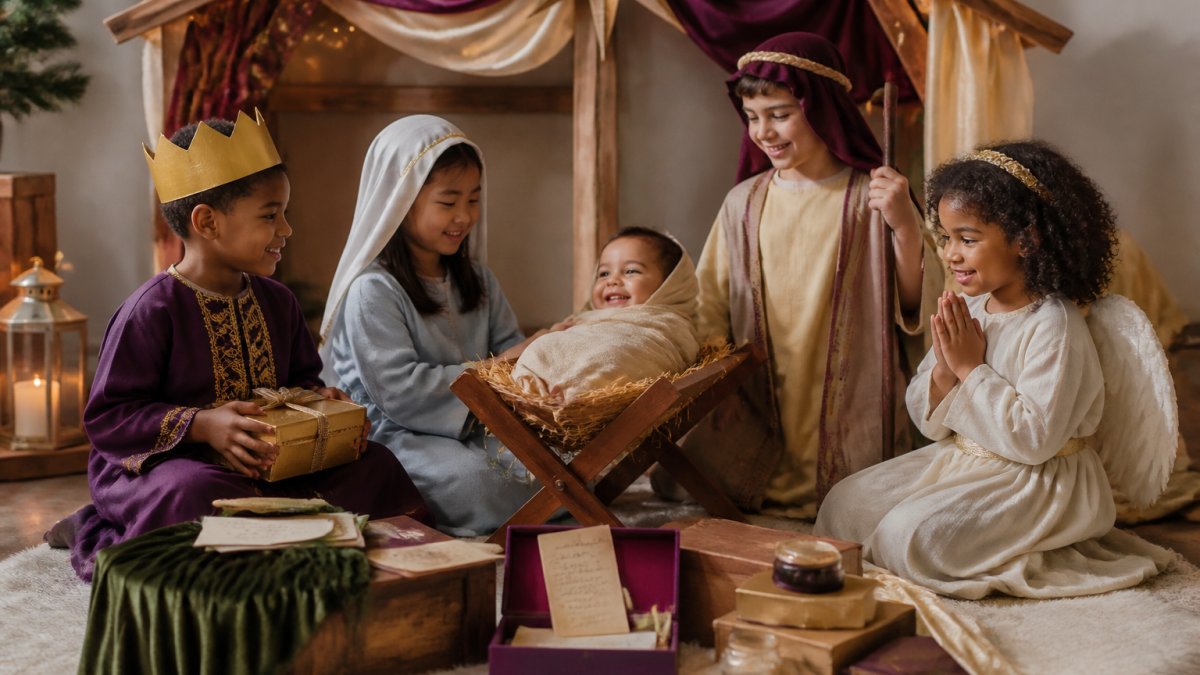
The Christmas story includes a journey and the birth of a baby. You can take time to share it with your child.
A few ways to make it real:
- Read one part of the story each week, not all at once.
- Let your child hold something connected to the story.
- Ask what each character might have felt.
- Keep the same routine each year so it becomes a memory.
A few faith-based resources can help bring these moments to life. The Jesus Storybook Bible tells each story as part of one larger narrative, the Bible App for Kids offers interactive, read-along stories young children can explore on their own, and The Beginner's Bible uses simple language and illustrations suited to little ones.
The Promise Letters™ offers faith-based Advent experiences with handwritten letters from the perspectives of Biblical figures, illustrated keepsakes, and ornaments. These resources bring Scripture to life through immersive storytelling. Parents of young children can explore whether this format suits their family.
The goal can be to share the story at home with your child.
Choose resources that fit your child and make space to share Scripture together.
Frequently Asked Questions
How do you study the Bible with a young child?
Keep sessions short and repeat often. Read or tell one story, ask two or three simple questions, and let the child retell it in their own words. Pair the story with something hands-on, like drawing a scene or holding a small object tied to it. For Bible study resources for young children, look for ones with clear pictures, short sentences and a single takeaway per story.
How long should Bible study be for young children?
Keep Bible study sessions short and adjust the length to your child. Watch for fidgeting and wandering eyes, and consider stopping when your child loses interest.
What activities help young children remember Bible stories?
After a story, ask the child to act it out, draw it, or tell it to a grandparent. You could also try crafts, matching games with Bible characters, or songs with repeated lines.
What are simple ways to start family Bible study?
Pick a time that already exists in your week, such as breakfast on Saturday or bedtime on Sunday. Use one resource for everyone rather than a different book per child. Let each person share one thing they noticed, and close with a short prayer. You can keep the routine simple and repeat it when it suits your family.
Ready to Start The Promise Letters™ This Advent?
The Promise Letters™ brings handwritten letters from the perspectives of Biblical figures, illustrated keepsakes, and ornaments into your family's Advent season. Explore the collection and start walking through the Christmas story together with your child. SHOP OUR LETTER COLLECTIONS
Other Faith-Based Bible Resources for Advent
The Promise Letters™ pairs well with other tools families use to walk through the Bible together. The Beginner's Bible brings classic Bible stories to life for young readers, VeggieTales offers playful retellings kids already love, and the Bible App for Kids gives families an easy way to read along each day. For a set of letters built specifically for the Nativity story, see The Promise Letters™: Christmas Collection.