 how-to
How to Create an Immersive Bible Study at Home
Last Updated: October 26, 2026
Quick Summary
To create an immersive Bible study at home, pick one scene of 8-15 verses, read it aloud twice, and step into a character by writing what you see, hear, want, and fear. An immersive Bible study works best in a twenty-minute rhythm of observation, interpretation, application, and prayer.
- Pick one scene of 8-15 verses rather than a whole book so the passage stays easy to enter.
- Read the passage aloud twice, circling physical details like weather, objects, bodies, and sounds.
- Write four first-person lines as a non-hero character: I see, I hear, I want, I fear.
- Keep observation, interpretation, and application in separate lanes, writing five observations before any interpretation.
- Set a timer for twenty minutes and keep a basket of cloths, pens, and sticky notes within reach.
Table of Contents
- What Makes a Bible Study Immersive
- A Step-by-Step Method for Studying a Bible Story
- Interactive Bible Study Ideas for Families
- Family Bible Study Activities That Bring Stories to Life
- Building a Bible Study Lesson Plan for Families
- Bible Journaling Supplies for Deeper Engagement
- A Worked Example: Studying Jonah in One Evening
- Common Mistakes That Break Immersion
- Setting Up Your First Immersive Study Night
- Ready to Start the Adventure?
- Frequently Asked Questions
What Makes a Bible Study Immersive
An immersive Bible study is a way of reading Scripture that moves you from watching the story to standing inside it. Instead of skimming a passage for a lesson, you slow down, picture the scene, and let the people in it become real.
That shift changes everything. Most of us learned to read the Bible for information. We hunt for the principle, underline the verse, and move on. The story never gets a chance to land.
When you treat a passage as a story with real people, real weather, and real fear, the words stop being flat.
Here is what separates the two modes:
- Reading asks, "What does this mean?"
- Entering asks, "What would I have felt standing there?"
- Reading keeps you at a safe distance.
- Entering puts you in the crowd.
You do not need a seminary degree or a special room. You need a Bible, a little imagination, and a plan you can repeat. Below are steps for creating an immersive Bible study at home, with activities for families.
The Difference Between Reading and Entering the Story
Reading covers ground. Entering the story covers you.
Think about the storm on the Sea of Galilee. A plain reading tells you the disciples were afraid. An immersive reading asks why seasoned fishermen would panic. It puts you on the wet boards, bailing water, watching the man asleep on a cushion. Now the question is not "what happened?" but "what would I have done?"
That is the whole method in miniature. Details become doors.
A Step-by-Step Method for Studying a Bible Story
What follows is a workflow for a narrative passage. The key is that every step produces something you can see: a note, a sketch, a question, a prayer.
The five-step workflow (with time boxes)
- Pick one scene (2 min). Not a whole book, one moment. Aim for 8-15 verses. The longer the passage, the harder it is to enter. Write the reference at the top of your page.
- Read it aloud twice (5 min). First pass for the flow of the story. Second pass with a pen in hand, circling every physical detail: weather, objects, bodies, distances, sounds. These details are the doors you will walk through later.
- Map the story (5 min). On one half-page, draw three columns: Beginning, Middle, End. Under each, list who is present and what changes. If nothing changes between beginning and end, you have picked a scene that is really a speech or a list, choose a different one.
- Step into a character (8 min). Choose one person other than the obvious hero. Write four lines in first person: I see… I hear… I want… I fear… This is where immersion actually happens, and it is where kids outpace adults.
- Ask three questions and pray (10 min). What did this person want? What did they fear? What did they learn about God? Then close with one sentence of prayer in that character's voice.
That is the whole loop.
Keep observation, interpretation, and application in separate lanes
A structured three-lane pass separates observation, interpretation, and application.
- Observation, what does the text actually say? Who, what, where, when, and which words repeat. Nothing here is a lesson yet; it is just evidence. Write at least five observations before you allow yourself an interpretation.
- Interpretation, what did it mean to the first hearers? Why did the author include this detail? What would a first-century listener have assumed that a modern reader misses? This is where context research lives (see below).
- Application, what does it ask of me now? Only after the first two lanes are full. Application that skips interpretation is how verses get pulled out of shape.
A practical guardrail: if your application could have come from any passage, it probably did. Good application names a specific detail from this scene.
A context checklist you can actually research
Here are questions to ask, and places to look for answers:
- Setting and geography. Where is this? How far did people travel, and how long would it take? A study Bible map or the notes in a good study Bible answer this in minutes.
- Time period and politics. Who was in power? What was the economic reality for a fisherman, a shepherd, a tax collector?
- Cultural customs. What did hospitality, meals, marriage, or burial look like in this world? Bible dictionaries and the introductory notes in most study Bibles cover the common ones.
- Literary context. What happens immediately before and after this scene? Why did the author place it here?
- Genre. This is the one most home studies skip. Narrative, poetry, prophecy, parable, and letter each ask to be read differently. A psalm is not a news report; a parable is not a history lesson. Before you imagine the scene, name the genre out loud.
A study Bible with maps and notes, plus a Bible dictionary, can help with context questions.
A worked example: Jonah 1 in one evening
Here is the workflow in action so the abstract steps become usable.
Pick the scene. Jonah 1:1-16. One storm, one ship, one runaway prophet.
Read aloud twice. First pass for the story. Second pass for details: Jonah is below deck, asleep, while pagan sailors pray to their own gods and throw cargo overboard. Note the repeated word fear, the sailors go from fearing the storm to fearing the LORD.
Map it. Beginning: God speaks, Jonah flees. Middle: the storm, the cargo thrown, Jonah's confession. End: the sea calms, the sailors worship. Something clearly changes, the sailors' fear turns toward God.
Step into a character. Choose a sailor, not Jonah. You have never met this God. A stranger on your ship admits the storm is his fault. Write: I see the waves, I hear the wind, I want to survive, I fear dying for another man's disobedience.
Ask the three questions. What did the sailor want? Safety. What did he fear? Dying for someone else's sin. What did he learn? That this God is worth fearing. Close by praying in the sailor's voice for someone you know who feels far from God.
That is a study night, observation, interpretation, application, and prayer.
If your family is preparing for Christmas, this is also the natural moment to bring in The Promise Letters™ Christmas Collection: each letter is written from a biblical figure's perspective, so the "step into a character" work you just practiced becomes a family ritual, read the letter aloud, dress as the character, hang the ornament, and mail the postcard to someone you love.
Interactive Bible Study Ideas for Families
These interactive Bible study ideas turn a passage into something everyone can touch, act out, or hold. The rule that makes them work: give every person a job. Passive listeners drift; participants stay. Below are specific instructions, materials, and age tweaks so you can run each one tonight.
1. Character letter (ages 6+)
Materials: paper, pens, one envelope per person.
How to run it: Read the passage aloud. Then have each person write a short letter as one character to a friend, Jonah writing to a fellow prophet, a sailor writing home. Keep it to five sentences. Younger kids can dictate while you write. Read the letters aloud in character voices.
Why it works: Kids who resist discussion will often write freely when they are pretending to be someone else. It also forces observation, you cannot write as a character you have not listened to.
2. Soundscape (ages 3+)
Materials: none, or a few household items (a bowl of dry rice for rain, a sheet of paper for wind).
How to run it: Read the scene slowly while the family makes its sounds, rain on a roof, wind in a boat, a crowd murmuring, oars creaking. Assign one sound per person. Pause the reading and let the sound fill the room for ten seconds.
Why it works: It is the fastest way to get small children inside a scene without any prep.
3. Freeze frame (ages 5+)
Materials: none.
How to run it: Read until a tense moment, then call "Freeze!" Everyone strikes the pose of a character at that instant, the sailor mid-throw, Jonah asleep. Walk around and ask each person one question: What are you feeling right now?
4. Hot seat (ages 8+)
Materials: one chair.
How to run it: One person sits in the chair and answers questions in first person as a character. The rest of the family asks. Rule: answers must stay inside what the passage supports. If someone invents a detail, the group gently asks, "Where did you see that in the text?"
5. Map it (ages 7+)
Materials: large paper, markers, a study Bible map for reference.
How to run it: Draw the journey on paper. Mark distances and travel times from your study Bible notes. Distance makes the story bigger, Jonah's flight from Joppa toward Tarshish reads differently when you see how far he was running.
6. Build the scene (ages 4+)
For hands-on builders, Bible Bricks offers brick-based kits that let children construct a scene from a Bible story.
7. The ornament ceremony and the postcard (all ages)
This ritual can connect a study night with the Advent season.
Materials: a keepsake ornament, a postcard, a pen, and a tree (or a branch in a jar if the tree is not up yet).
How to run it: After the reading, one person hangs the ornament and says one sentence about what the story promised. Then each family member writes one line on the postcard to someone they love, telling them what they learned. Drop it in the mailbox the next morning, mailing it turns the study outward.
The The Promise Letters™ Christmas Collection offers letters written from the perspective of biblical figures, illustrated keepsakes, and an ornament. Families can read the letter, dress as the character, take turns reading the parts, hang the ornament in a short ceremony, and mail a postcard to someone they love.
Family Bible Study Activities That Bring Stories to Life
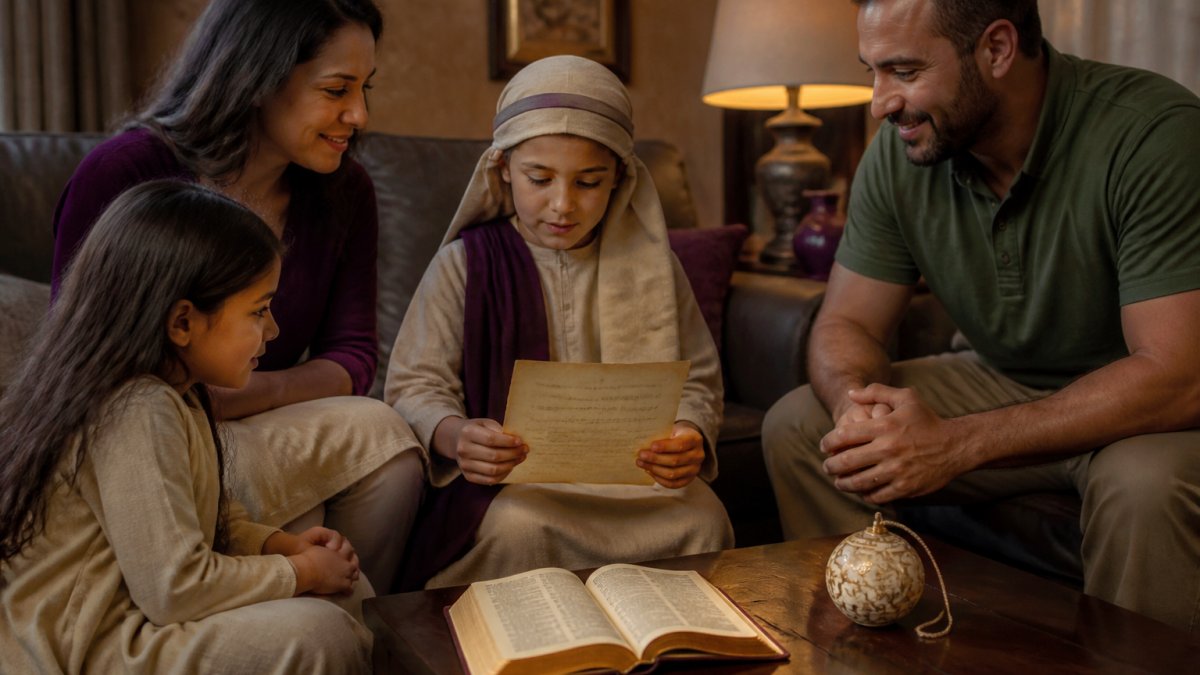
Family Bible study activities can give everyone a job.
Dress the part. Keep a basket of simple cloths, scarves, and head coverings near your study spot. When someone reads a character's part, they wear the part. A dish towel becomes a shepherd's headdress in seconds.
Take turns reading. Rotate voices so every character sounds different. Let the youngest reader handle the shortest lines.
Add an ornament to the tree. After the reading, one person can hang a keepsake ornament and say a sentence about what the story promised.
Mail a postcard. Have each family member write one line to someone they love, telling them what they learned. Dropping it in the mailbox turns the study outward.
The The Promise Letters™ Christmas Collection was built for exactly this. Each letter arrives written from the perspective of a biblical figure, with illustrated keepsakes and an ornament. Families read the letter, dress as the character, and mail the postcard each week to someone they love.
Building a Bible Study Lesson Plan for Families
A Bible study lesson plan for families can have a regular rhythm.
Use this simple template each week:
Part of the Plan | Time | What Happens |
|---|---|---|
Gather and light a candle | 2 min | Signal that this time is different |
Read the passage aloud | 5 min | Two readers, slow pace |
Imagine the scene together | 5 min | Sound effects, freeze frames, questions |
Hang the ornament | 2 min | One sentence of thanks or promise |
Pray and send | 3 min | Pray for the person receiving the postcard |
Rotate who leads each week. Give kids the reading and the prayer. Ownership builds habit.
Bible Journaling Supplies for Deeper Engagement
You do not need much. A few good Bible journaling supplies keep the focus on the text instead of the craft aisle.
Start with:
- A wide-margin Bible or a plain notebook
- Fine-tip pens that do not bleed through thin paper
- Colored pencils for maps and scenes
- Washi tape or sticky notes for marking passages
- A small envelope for each week's postcard
You can draw the scene, not the decoration. Sketch the boat, the storm, the sleeping man. Write one observation, one question, one prayer.
Keep the text first.
A Worked Example: Studying Jonah in One Evening
Here is the method in action. Set aside one evening for Jonah 1, and watch the story open up.
Step 1: Pick the scene. Jonah 1:1-16. One storm, one ship, one runaway prophet.
Step 2: Read aloud twice. First pass for the story. Second pass for details. Notice that Jonah is asleep below deck while sailors pray to their own gods.
Step 3: Map it. Beginning: God speaks, Jonah flees. Middle: the storm, the cargo thrown overboard, Jonah's confession. Ending: the sea calms, the sailors worship.
Step 4: Step into a character. Choose a sailor. You have never met this God. A stranger on your ship admits the storm is his fault. What do you feel?
Step 5: Ask the three questions. What did the sailor want? Safety. What did he fear? Dying for another man's disobedience. What did he learn? That this God is worth fearing.
Close the night by hanging an ornament and praying for someone who feels far from God.
Common Mistakes That Break Immersion
Talking about a story is one way to study it; imagining the scene is another.
Watch out for these traps:
- Over-explaining. Stop teaching and let the scene breathe.
- Rushing to the moral. The lesson lands better when it arrives late.
- Skipping context. Know the time period and setting before you imagine. A shepherd in first-century Judea lived nothing like a modern farmer.
- Too many people. More than eight voices and the story gets lost.
- Forgetting genre. Poetry, parable, and history each ask to be read differently. Treat a psalm like a news report and it goes flat.
One more: do not correct every imaginative detail. If a child pictures Jonah in a rowboat instead of a cargo ship, note it gently later.
Setting Up Your First Immersive Study Night
Your first night should be easy to repeat. Set up once, then reuse the same spot every week.
- Choose a consistent place, ideally with a table and soft light.
- Put a basket of cloths, pens, and sticky notes within reach.
- Print or write the passage on a single sheet so eyes stay off screens.
- Pick one ornament and one postcard for the week.
- Set a timer for twenty minutes.
- End with prayer and a sentence of thanks.
You can begin with a simple first night. Choose a place, gather a few supplies, and read the story out loud.
Immersive Bible study at home can be a way to give a passage your attention. Pick a scene, read it slowly, and imagine the people in it.
Ready to Start the Adventure?
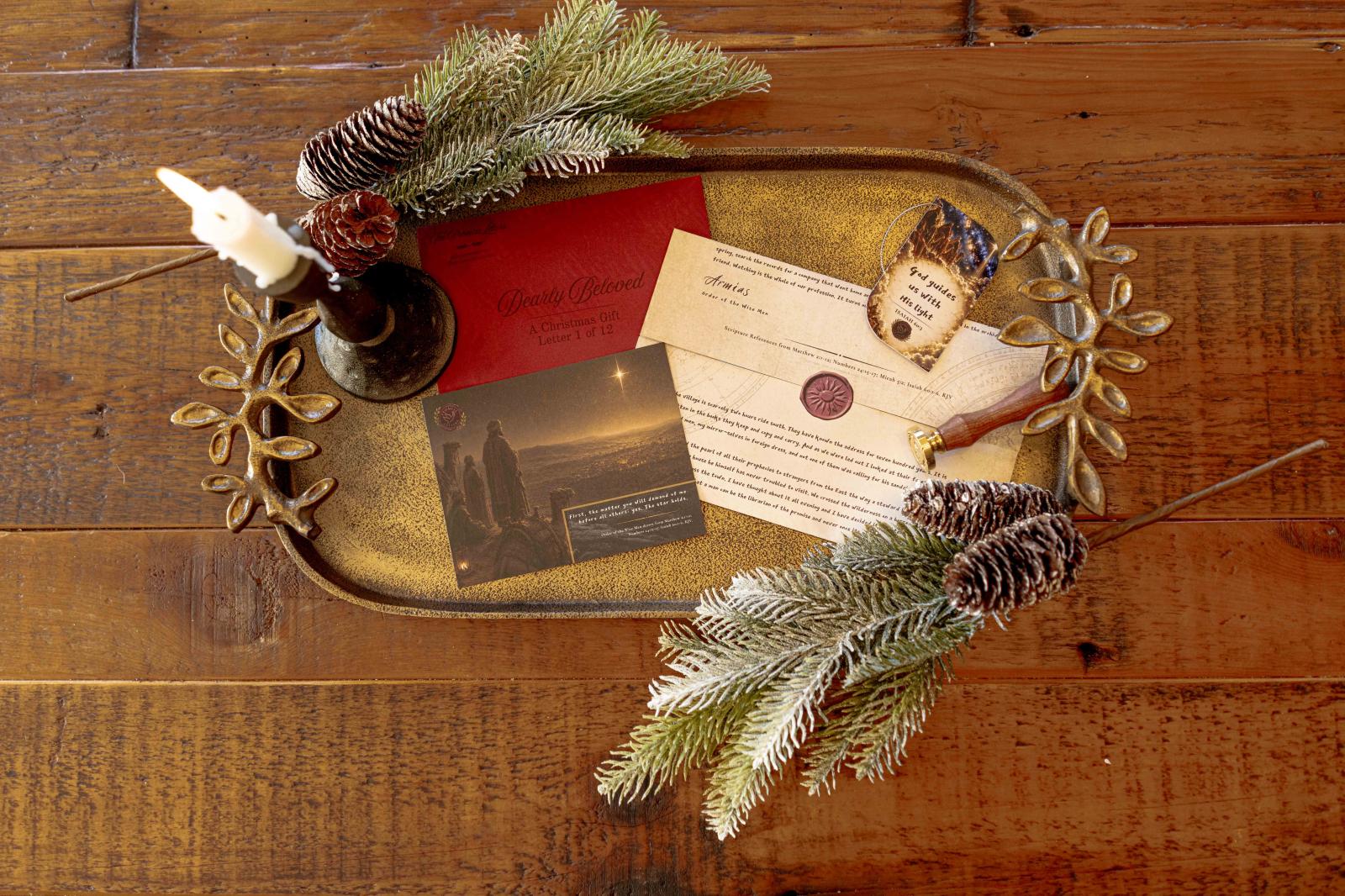
If you’d like a very easy way to start your first immersive Bible study - we’d love to introduce you to The Promise Letters: Christmas Collection.
Each week leading up to Christmas Day, you’ll receive a handwritten letter from a key Biblical voice straight from the first Christmas story. Here, you can see a letter from Armias, one of the Magi. You can read his account out loud to your family, send the postcard to a loved one and hang God’s promise from his story on your tree!
Frequently Asked Questions
How can families make Bible study more engaging at home?
Make the story physical and shared. Read a passage aloud, then assign each person a character and let them retell the scene in their own words. Add one sensory element, such as lighting a candle, dressing in a simple costume, or placing an ornament on the tree as you finish. Keep sessions to 15-20 minutes for young children and let them ask questions without correction. The goal is participation, not performance.
What supplies do you need for an interactive Bible study?
Start with a Bible in a translation your family reads comfortably, a notebook per person, and a few pens or colored pencils. Add sticky notes for marking passages, a map or printed timeline for context, and index cards for writing character observations. Bible journaling supplies such as washi tape, watercolor pencils, and a blank journal can be used for journaling. For storytelling nights, simple costumes, a candle, and a set of ornaments or illustrated keepsakes turn a reading into an event.
How long should a family Bible study last?
Match the length to the youngest attention span in the room. Choose a length that suits the people taking part. You can divide the time among reading, discussion or activity, and prayer or journaling.
How do you plan a family Bible study for different ages?
Choose one story and give each age group a different entry point. Young children can act out the scene or color a picture of it. Older children can track the plot and identify the conflict. Adults can examine historical context and character motivation. Everyone then shares one observation in a single conversation. This keeps the passage the same while the depth varies.